Author: Kirk Peters

Letter from the President

Dear PBPS Members, Colleagues, and Friends,

November is Pancreatic Cancer Awareness Month, a time to raise awareness of one of the most devastating malignancies affecting patients worldwide and to reaffirm our collective commitment to improving outcomes for those impacted by this disease. As pathologists, clinicians, scientists, trainees, patients, advocates, and caregivers, we share a common goal: advancing early detection, diagnosis, and treatment of pancreatic cancer through research, innovation, education, and collaboration.

Despite significant progress in surgical oncology, systemic therapies, molecular pathology, and biomarker discovery, pancreatic cancer remains a major global health challenge. It continues to be one of the leading causes of cancer-related mortality worldwide. Early detection remains difficult, as many patients present with advanced disease when treatment options are limited and outcomes remain poor. These realities underscore the urgent need for greater public awareness, increased research investment, improved screening and diagnostic approaches, and the development of more effective therapies.

In this effort, the role of pathologists has never been more important. Through accurate histopathologic evaluation, integration of molecular and genomic findings, identification of emerging biomarkers, and participation in multidisciplinary patient care, pathologists play a central role in guiding clinical management and advancing precision medicine. Pathology-driven research continues to improve our understanding of pancreatic cancer biology and to identify new opportunities for earlier detection and therapeutic intervention.

The Pancreatobiliary Pathology Society (PBPS) remains deeply committed to supporting these efforts. Through educational programs, international collaborations, research initiatives, mentorship opportunities, and scientific exchange, PBPS strives to advance knowledge and foster innovations that improve the care of patients with pancreatic cancer and other pancreatobiliary diseases. Our strength lies in our diverse and global membership, united by a shared commitment to excellence in pathology and patient care. By bringing together experts from different disciplines, institutions, and regions of the world, we enhance our ability to address the complex challenges posed by pancreatic cancer and accelerate progress toward better patient outcomes.

Pancreatic Cancer Awareness Month also reminds us of the importance of advocacy and community engagement. Raising awareness helps educate the public about pancreatic cancer, highlights the need for continued research and funding, and supports patients and families navigating the challenges of this disease.

As we observe Pancreatic Cancer Awareness Month, let us reaffirm our dedication to advancing research, improving diagnostic accuracy, mentoring the next generation of pathologists, and strengthening multidisciplinary and international collaborations. Together, we can continue to expand our understanding of pancreatic cancer and translate scientific discoveries into meaningful benefits for patients and their families.

On behalf of the PBPS Executive Committee, thank you for your continued contributions to our society and to the patients we serve. Through scientific discovery, education, collaboration, advocacy, and innovation, we can continue to advance the field of pancreatobiliary pathology and contribute to the fight against pancreatic cancer.

Sincerely,

Huamin Wang, MD, PhD
President
Pancreatobiliary Pathology Society (PBPS)
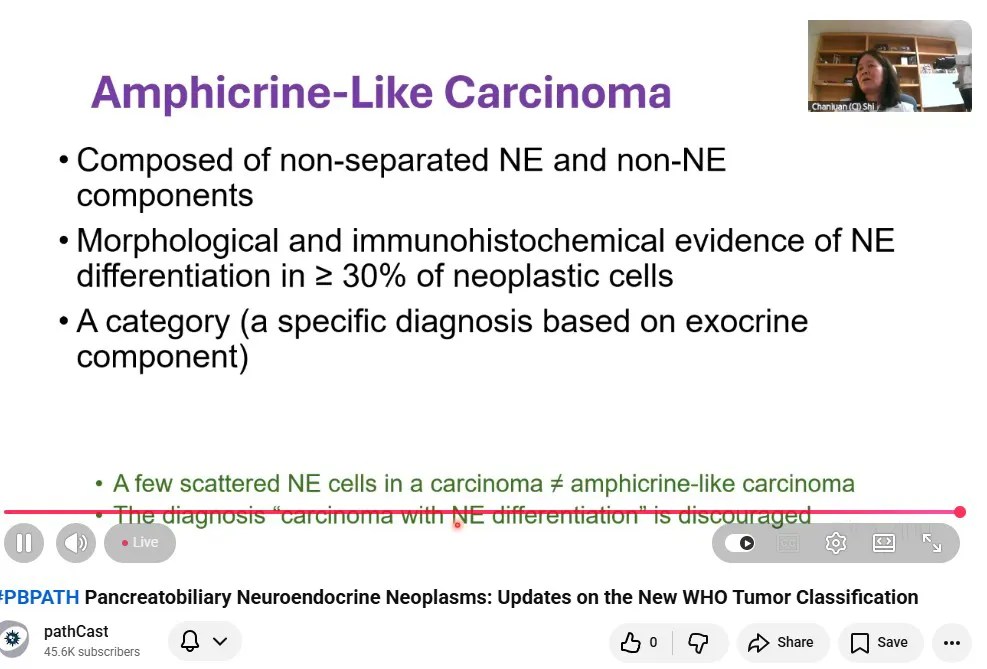
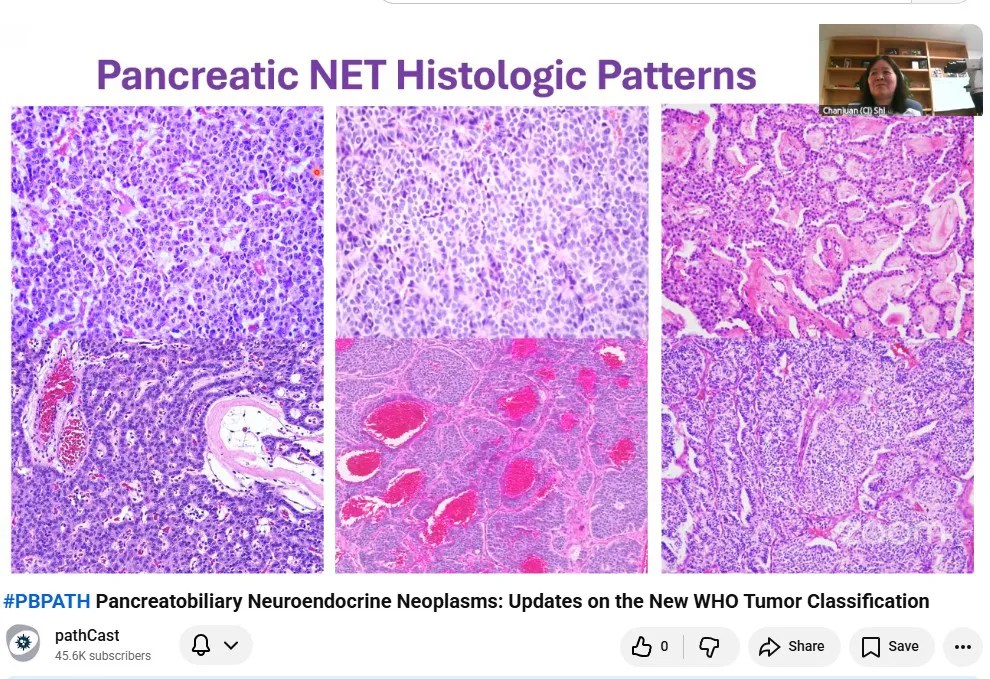
PBPS-pathCast lecture series

The inaugural session of our educational lecture series, presented in partnership with pathCast, launched on June 30, 2026, with a lecture by Dr. Chanjuan Shi, Professor of Pathology at Duke University.

Dr. Shi, an internationally recognized expert in gastrointestinal and pancreatobiliary pathology, presented “Pancreatobiliary Neuroendocrine Neoplasms: Updates on the New WHO Tumor Classification.”

The session highlighted important updates in the latest WHO classification and evolving concepts in the diagnosis and classification of pancreatobiliary neuroendocrine neoplasms.

The lecture was livestreamed on Facebook and YouTube and attracted approximately 200 viewers from more than 15 countries, providing an excellent start to this global educational initiative.

The lecture recording is available here:  https://www.youtube.com/live/-h_uZq9ivoY?si=CZHEwlA6-a3D–Rb

Letter from the President

Dear Members, Colleagues and Friends,

It is a tremendous honor and privilege to serve as President of the Pancreatobiliary Pathology Society (PBPS). I am excited to work alongside all of you as we continue to advance our mission and build on the strong momentum of our community.

It was wonderful to see many of you in San Antonio. It was an absolute pleasure to reconnect with longtime colleagues and friends and welcome new members into our rapidly growing community. The strong presence of PBPS at this year’s USCAP Annual Meeting highlights the remarkable energy, momentum, and growing influence of our field. Our companion meeting was exceptionally well attended, with engaging discussions from the basics of grossing pathology to cutting-edge digital and molecular pathology on pancreatobiliary cancers and their precursor lesions that highlighted both the complexity and the rapid evolution of pancreatobiliary pathology. I would like to thank all of the speakers, Drs. Olca Basturk, Xuchen Zhang, Michael Noe and Laura Wood and the moderators, Drs. Huaibin Mabel Ko and Massimo Milione for their outstanding work.

It is worth noting that our new initiative at this year’s USCAP Annual Meeting, the PBPS Poster Walk, was a great success and very well received by the presenters. Building on this momentum, PBPS will continue the poster walk at next year’s USCAP meeting and will introduce a PBPS Best Poster Award to recognize the most outstanding poster.

I would like to congratulate Dr. Wen‑Yu Hsiao, gastrointestinal pathology fellow at Emory University, on receiving the PBPS Best Abstract Award for her outstanding study titled “FGFR2/3‑Altered Cholangiocarcinoma: Comprehensive Clinicopathological, Phenotypic, Genomic, and Survival Analysis.” This study was selected by the Education Committee based on its innovation, strong study design, clinical relevance, and the quality of the abstract presentation. We are delighted to recognize her achievement.

I would also like to welcome our newly selected Vice President, Dr. Grace Kim, and our new Chair of the Education Committee, Dr. Yoh Zen. We are grateful for their willingness to serve, and we look forward to working closely with them as we continue to strengthen our educational mission and advance the goals of our society.

PBPS continues to grow and evolve in exciting ways. Over the past year, we have expanded our educational initiatives through impactful international collaborations, including a joint PBPS-European Society of Pathology (ESP) session at the 37th Annual European Congress of Pathology in Vienna, Austria (September 2025) on cystic lesions of the pancreatobiliary tract (Speakers: Drs. Monika Vyas and Michelle Reid; Moderator: Dr. Huamin Wang), as well as a joint PBPS–IAP session at the 14th Asia Pacific IAP meeting in Bangkok, Thailand (November 2025) focusing on pancreatic cytopathology and histopathology (Speakers: Drs. Barbara Centeno and Claudio Luchini). These collaborations reflect our commitment to strengthening global engagement.

Moving forward, we are committed to further strengthening our educational offerings, enhancing member engagement, and building strategic collaborations to further expand our national and international partnerships.  We will continue to build a vibrant, dynamic platform that supports learning at every career stage, fosters collaboration, and advances excellence in both clinical practice and research.

I encourage all members and fellow pancreatobiliary pathology enthusiasts to actively participate in the PBPS initiatives. Now is a great time to become a member and enjoy full benefits from our society (https://pbpath.org/membership-account/). Your involvement is essential to the continued success and growth of PBPS.

Finally, I would like to express my heartfelt appreciation to our past President, Dr. Michelle Reid, and our past Chair of Education Committee, Dr. Claudio Luchini, for their outstanding leadership, vision, and dedication in building such a strong foundation for our society. I am deeply grateful to our committees and Executive Committee for the tremendous work they do behind the scenes to keep PBPS thriving.

I am truly excited about what we can accomplish together in the years ahead. Thank you all for your continued support and commitment to PBPS.

Huamin Wang, MD, PhD
President, PBPS

Letter from the President

Dear Members and Fellow Pancreatobiliary Pathology enthusiasts,

Spring is in the air – which means USCAP season is here again. USCAP 2026 will be held in San Antonio, Texas, and PBPS is looking forward to a terrific meeting with all of you.

The PBPS warmly invites you to our Annual Companion Meeting on Sunday, March 22 at 10:30 AM in Room 301B at the Henry B. González Convention Center.

We’ve prepared an outstanding program, “The Future of Everyday Diagnostics in Pancreatobiliary Pathology”, moderated by Drs. Huaibin Ko and Massimo Milione and featuring four exceptional speakers:

  • Macroscopic Examination of Pancreatic Specimens: Pros and Cons of the Different Methodologies
    Olca Basturk, MD – Memorial Sloan Kettering Cancer Center
  • Immunohistochemistry and Digital Pathology for Pancreatobiliary Diseases
    Xuchen Zhang, MD – Yale University School of Medicine
  • Molecular Studies and Cyst Fluid Analysis in Pancreatobiliary Pathology
    Michael Noë, MD – Amsterdam UMC (representing the European Society of Pathology)
  • Pancreatobiliary Precursor Lesions: Now and in the Future
    Laura D. Wood, MD – Johns Hopkins University

For program updates, highlights and pre-session speaker Q&A, please follow us on:

Our Annual Business Meeting will follow promptly after the scientific session. I hope you’ll join us as your engagement and input truly shape the direction and momentum of PBPS.

Additional USCAP Highlights

As we’ve done for the past two years, PBPS will host a joint reception with the Gastrointestinal Pathology Society (GIPS) and Hans Popper Hepatopathology Society (HPHS) on Sunday, March 22, 5:30–7:30 PM, in the Alamo Ballroom Salon C at the San Antonio Marriott Riverwalk, 889 East Market Street, San Antonio, TX 78205.

New this year, we will have a PBPS poster walk on Tuesday March 24th during the afternoon poster session where Executive and Education Committee members will visit with all Pancreatobiliary-related poster presenters to hear more about their exciting research. We hope to make this an annual event.

You are also invited to the Evening Specialty Conference on Pancreatobiliary Pathology on Tuesday, March 24, 7:00–8:30 PM, Room 302B, moderated by Dr. Aatur Singhi, and featuring “Updates to the WHO Classification of Pancreatobiliary Tumors: Key Changes for Clinical Practice”. Speakers include Drs. Stefano La Rosa, Chanjuan Shi, Laura Tang, and David Klimstra.

A personal note as I rotate off as President

This meeting marks the end of my term as PBPS President. It has truly been my privilege to serve this Society. Thank you to our members for your engagement and support, to our committees for all the work you do behind the scenes all year long, and to our Executive Committee for the steady leadership that keeps PBPS strong. PBPS thrives because of its collegial, generous membership, and it’s been a privilege to serve and help strengthen that foundation.

I’m also excited to support Dr. Huamin Wang as he steps into the Presidency. He is an exceptional leader, and I’m looking forward to continuing to work with him and the Executive Committee as PBPS grows and evolves.

If you have not yet done so, I hope that you’ll continue your commitment to PBPS by renewing your membership here: https://pbpath.org/membership-account/

As always, thank you for your participation, and I’ll see you in San Antonio.

Sincerely,

Michelle Reid, MD, MS
Outgoing President
Pancreatobiliary Pathology Society

Letter from the President

Dear PBPS Members,

Tomorrow, November 20, is World Pancreas Cancer Day – a day when the world comes together to raise awareness about a cancer that remains one of the most lethal.  Let us pause to acknowledge the patients, families, and friends whose lives have been impacted by this disease and remember those who have passed away. Behind every case we sign out is a person, a story, and a loss felt by many. This is why our work matters. 

The research, guidelines, and collaborations our community produces are moving the needle toward earlier diagnosis, better classification, and more effective treatment.

I encourage you to wear purple tomorrow to raise awareness and to use the day to recommit to pancreas cancer research and our shared goal of improving outcomes and, ultimately, finding a cure.

Sincerely,

Michelle D. Reid, MD, MS
President, Pancreatobiliary Pathology Society 

Pancreatobiliary Pathology from A to Z: A PBPS Crash Course

We are pleased to announce the successful completion of our interactive microscopy course, held in collaboration with USCAP at the USCAP Interactive Center in Palm Springs, CA, from May 19–21, 2025.

Participants from around the world joined us for three days of expert-led sessions, virtual microscopy workshops, and case-based discussions focused on pancreaticobiliary pathology. The course covered surgical and cytopathology, as well as principles of gross and frozen section evaluation.

We received enthusiastic feedback, with many praising the practical content, intuitive format, and high-quality case material.

Our sincere thanks to the faculty, technical team, and attendees for making this a resounding success. We look forward to future educational initiatives in digital pathology.